

The semiconductor shortage has tested the resilience and adaptability of the entire automotive industry. Since the start of the crisis—triggered by the global chip shortage and supply chain pressures—manufacturers and suppliers have had to rethink processes, diversify markets, and invest in innovation to keep production running.
Thanks to its strong network of automotive suppliers and the support of Autoparts From Spain, the platform that brings together Spain’s leading automotive component manufacturers, the country demonstrates how flexibility, technology, and international collaboration are key to overcoming one of the sector’s greatest challenges in recent years.
The automotive industry is facing a genuine crisis driven by the lack of microchips, supply chain tensions, and rising raw material prices. This “automotive sector crisis” stems from two main factors: a surge in global semiconductor demand exceeding post-pandemic expectations, and production constraints affecting mature chips and the sensors required for vehicles. In addition, rising costs of metals, plastics, and logistics have added even more pressure.
In modern automotive manufacturing, electronic components, temperature sensors, and electrical equipment are among the most severely affected items, as they are essential for connected, electric, and hybrid vehicles.
The semiconductor shortage has not only impacted major vehicle manufacturers; it has also triggered a domino effect across the entire Spanish automotive supply industry, which provides essential parts and systems worldwide.
Suppliers now face a scenario where long-term planning becomes more complex, delivery times stretch out, and procurement costs soar. In this environment, anticipation, innovation, and collaboration between companies are critical to ensuring production continuity and maintaining global competitiveness.
Automotive microchips and sensors have become the core of intelligent vehicle systems: electronic control units, driver assistance systems, temperature sensors, emissions control, and more. When semiconductor production is limited, a key part of the manufacturing process comes to a halt—often causing disruptions that can stop production across Europe.
Likewise, engine systems and components, as well as transmission systems, are increasingly integrated with advanced electronics, pushing this crisis beyond the realm of the “simple chip.”
Slower manufacturing of both parts and vehicles has become a reality. Recent reports indicate that the semiconductor shortage is causing technical stoppages or slowdowns on production lines.
Additionally, supply chains are being forced to manage higher stock levels, adjust purchasing processes, and negotiate with suppliers facing bottlenecks. All of this increases lead times and costs, affecting both manufacturers and suppliers.
In the automotive aftermarket, the semiconductor crisis also takes a toll: parts that include automotive microchips or sensors take longer to arrive, affecting after-sales service, creating shortages of replacement parts, and raising repair costs for workshops and distributors. This happens even when the metal component itself is available, but the essential electronics are not —forcing delays or redesigns.
Companies in the sector have leveraged industrial expertise, technological innovation, and global openness to overcome the effects of the semiconductor shortage. Throughout this transformation, Autoparts from Spain has served as a true catalyst—boosting the global visibility of Spanish automotive suppliers and strengthening their position as reliable partners within the global value chain.
Autoparts from Spain has consolidated itself as a key meeting point and international promotion platform for Spanish component manufacturers. At a time when chip shortages strain production and require new strategies, the platform strengthens Spanish brands in key markets and provides a global showcase for exporting automotive components.
Its work enables national suppliers to remain competitive and reinforce their reputation as trusted automotive partners, ensuring quality, compliance, and continuity of supply in an increasingly demanding environment.
In a global environment where commercial and logistical tensions can disrupt supply chains at any moment, internationalisation has become a fundamental tool for stability. With the support of Autoparts from Spain, Spanish suppliers have expanded beyond Europe into strategic markets such as Latin America, Africa, and Asia, where the demand for reliable, sustainable components continues to grow.
This international expansion helps diversify risks, balance production, and strengthen Spain’s role as a solid and competitive industrial partner. In addition, it highlights the versatility of the Spanish catalogue, which ranges from body parts and rubber and plastic components to high-precision metalwork and electrical systems.
Investing in automotive innovation is essential. Suppliers must adopt more agile processes, technologies for substituting or calibrating alternative semiconductors, and production structures capable of adapting quickly. At the same time, sustainability in automotive manufacturing becomes an important differentiator.
Expanding into regions outside Europe—Latin America, Southeast Asia, Africa—helps reduce dependence on specific semiconductor production hubs and congested logistics routes. This strategy minimises risks and opens access to new supply chains and emerging demand.
Strategic alliances between Spanish suppliers and global automotive manufacturers help increase scale, share risks, and secure critical supplies. In this context, automotive service solutions and workshop equipment with digital capabilities play a key role in supporting the transformation.
The crisis has acted as a catalyst for the sector’s digital transformation. Digitalisation, Industry 4.0, traceability, and data intelligence are becoming essential tools to anticipate and respond to supply chain disruptions across the global automotive sector.
The shift toward electric and connected mobility is accelerating the need for components, sensors, power electronics, and software—opening new opportunities for trusted automotive suppliers. Spain is well positioned to benefit from this transition.
Spain has the potential to consolidate itself as a reliable strategic partner in the future of mobility. Thanks to its industrial structure, international expansion, and platforms such as Autoparts from Spain, Spanish suppliers are poised to strengthen their status as trusted automotive partners.
A combination of explosive global demand for microchips, highly concentrated production in a few countries, export restrictions, and limited short-term alternatives created severe tensions in the automotive supply chain.
Autoparts from Spain strengthens visibility, internationalisation, and resilience for Spanish suppliers—helping them diversify markets, reduce dependencies, and become more robust within the global automotive value chain.
Key strategies include investing in technological innovation and flexible processes, diversifying geographically, forging strategic collaborations with global manufacturers, and leveraging digitalisation and alternative production models.
The semiconductor crisis allows Spain to reinforce its position as a resilient, innovative, internationally competitive supplier ecosystem.
The semiconductor shortage has accelerated profound changes in the automotive sector. Spanish automotive suppliers have shown remarkable resilience by combining technological innovation, production flexibility, and a strategic outlook focused on sustainability and internationalisation.
Rather than slowing development, the crisis has strengthened Spain’s industrial capabilities, inspiring companies to adopt more efficient, digitalised, and sustainable processes. New technological solutions, increased collaboration, and the rise of Industry 5.0 have enabled many suppliers to remain competitive and continue serving global markets despite the shortage.
Autoparts from Spain plays a decisive role in this transformation, promoting the excellence of national manufacturers and showcasing the quality of the Spanish automotive component industry. Through joint promotion and sectoral cohesion, Spain reinforces its position as a reliable, innovative industrial partner prepared for the future of mobility.
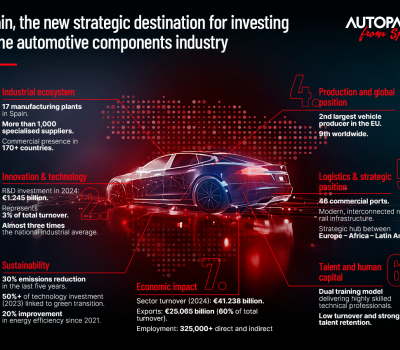
Spain has established itself as one of the most attractive countries for investing in the automotive sector. This is confirmed by the report “Reasons to invest in Spain,” prepared by Deloitte for SERNAUTO, which analyzes the factors that strengthen Spain’s position as a key hub for the new mobility ecosystem.

Autoparts from Spain strengthens the international projection of Spanish automotive components at Automechanika Dubai 2025
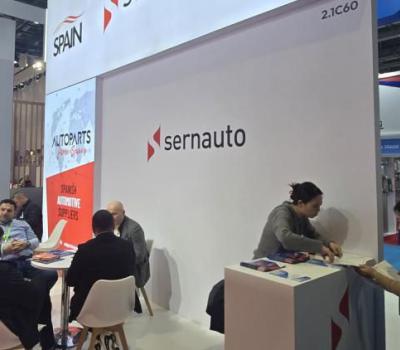
Autoparts from Spain strengthens its international presence by participating in Automechanika Shanghai 2025, a key event to connect with the Asian market and showcase the innovation of the Spanish components sector.